Our goal
To show, end to end, that Product Engineer LLC can take a rough product idea — the kind written on a single page — and turn it into a complete, production-ready Design History File (DHF): every market need, requirement, drawing, safety analysis, test and approval, all written down and all connected to each other so nothing is lost and every decision can be traced back to a reason.
We chose a demanding example on purpose: a battery-powered device that must protect vaccines inside insulated shippers, survive from −30 °C to +60 °C, run for up to 90 days on a charge, and satisfy health-and-safety rules in several countries. The pages that follow walk through the same journey a serious product team would take — in plain language — and each step is backed by the actual documents we produced.
Every figure above is drawn from the master record you can download at the end of this page.
The concept & the four big decisions
STARTING POINT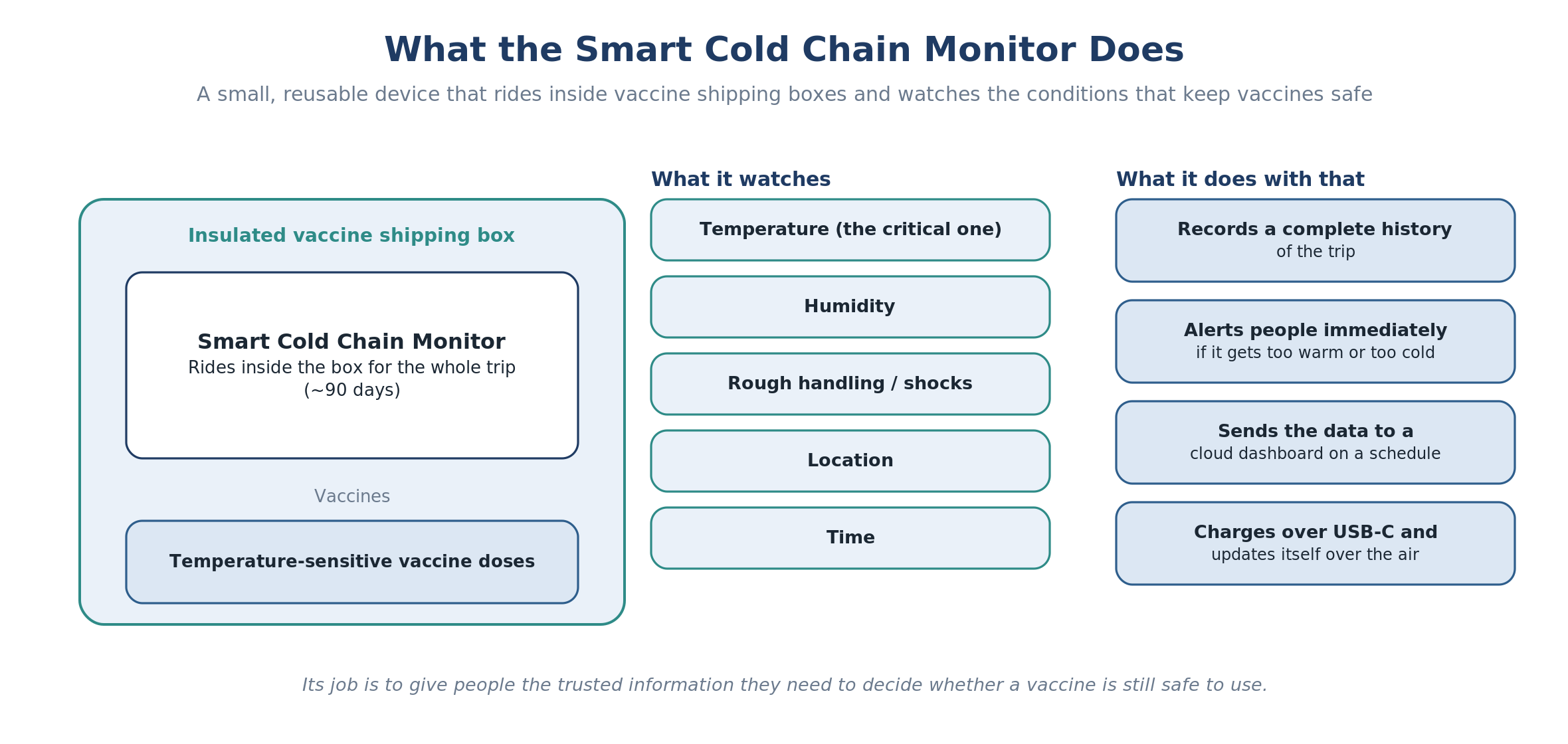
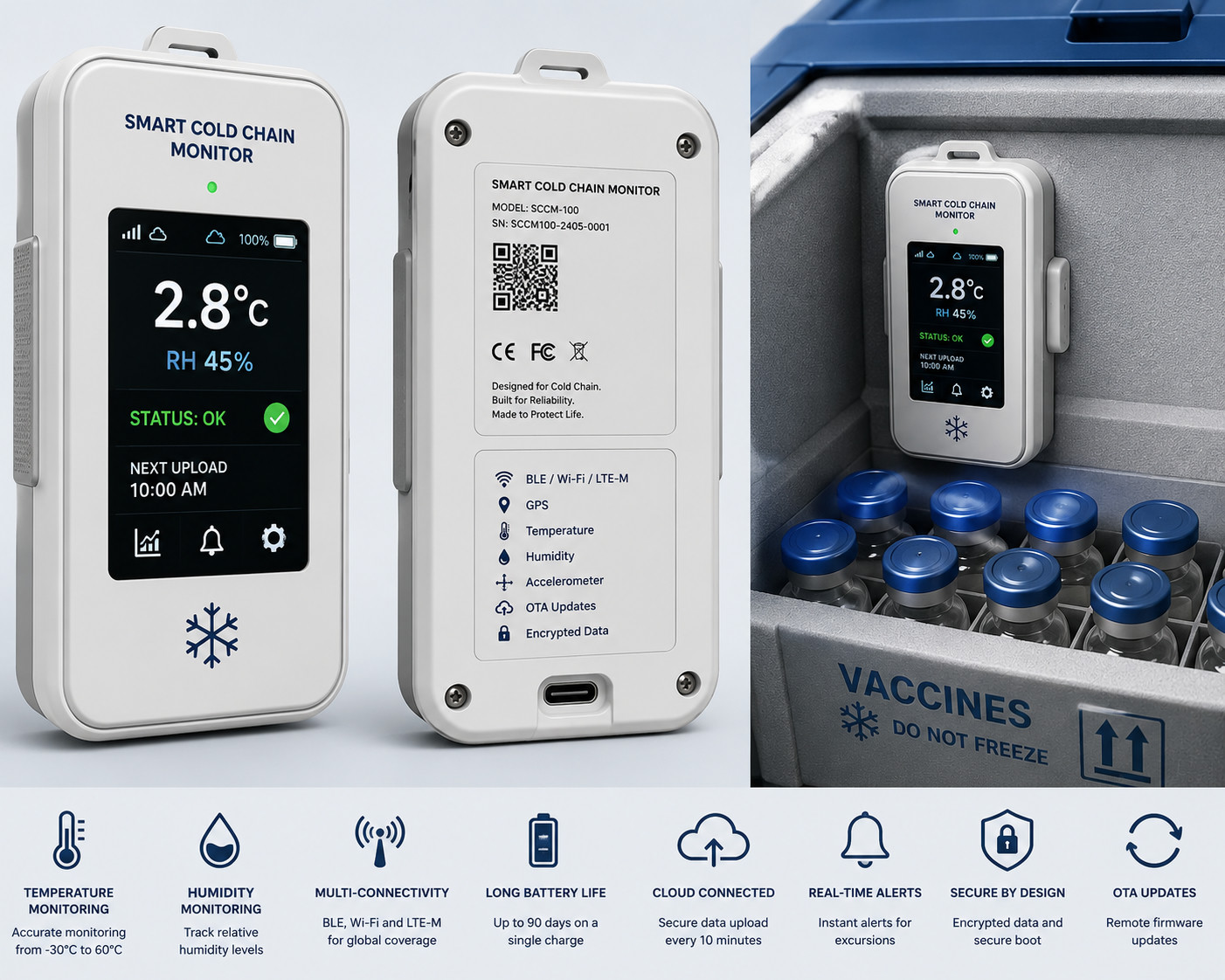
The idea we were given, in one breath: a small, battery-powered monitor that rides inside an insulated vaccine shipper, keeps a continuous record of temperature, humidity and shock, warns people the moment the load gets too warm or too cold, and uploads its data to the cloud. It charges by USB-C, updates its own software over the air, and is meant to last about 90 days per charge across a punishing −30 °C to +60 °C range.
Before any real engineering can start, four unanswered questions in that idea had to be settled — because everything downstream depends on them:
- Is it single-use or reusable? — Reusable. The USB-C charging and rechargeable battery only make sense for a multi-trip device.
- How does the data get out? — It records on board, uploads on a schedule, and sends an instant alert the moment something goes wrong — so battery life and real-time warnings can both be met.
- What powers it in deep cold? — A low-temperature rechargeable battery, carefully rationed. This is the single hardest part of the whole product, so we flagged it as the top risk from day one.
- Which countries’ rules apply? — Several at once: global vaccine (WHO), European distribution, US, plus the international rules for shipping lithium batteries by air.
The development journey
THE ROADMAP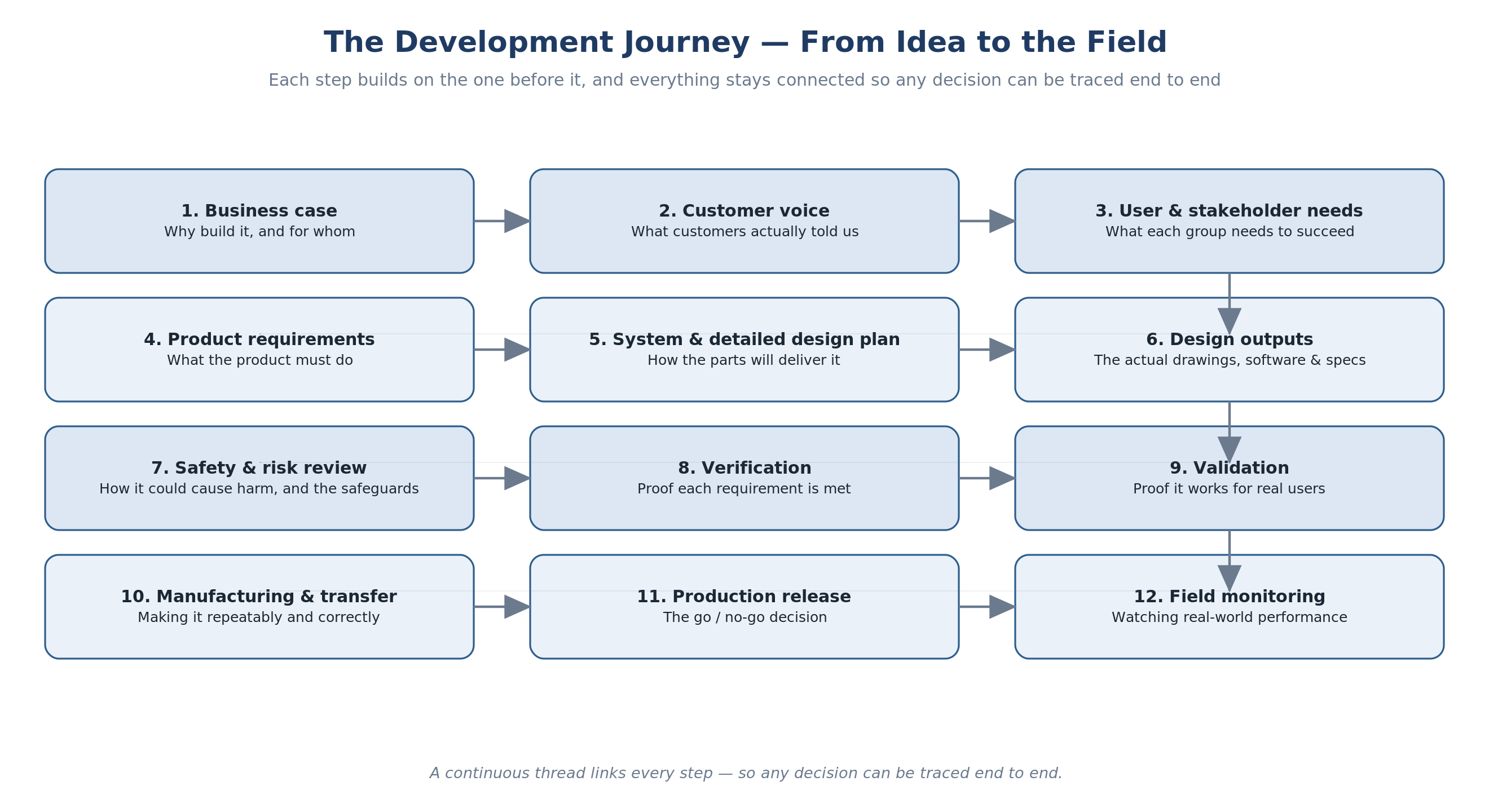
Good products are not designed in one leap. They are built up in deliberate steps, where each step answers a question the next one needs. We start with why we are building it and for whom, turn that into what it must do, then how it will do it, then the actual drawings and software, then proof that it is safe and that it works, and finally how we make it and watch it in the real world.
The rest of this page follows exactly that path. The important part is not any single step — it is that every step stays connected to the ones around it, so at the end you can pick any drawing or test and trace it all the way back to a customer need.
Listening to the market & the customers
STAGES 1–3First we asked who actually lives with this problem and what they truly need. The answer spans a whole chain of people: vaccine makers who must prove their product stayed safe, distributors who get blamed for damage they didn’t cause, logistics teams who can’t have shipments delayed, health programmes running clinics with no reliable power or phone signal, and the nurse at the end of the road who just needs to know “can I use this stock or not?”
We captured what each of them said in their own words, then translated those voices into clear, testable needs. A few themes came back again and again:
- “Tell me before it’s too late, not at delivery.” — real-time warning, not an after-the-fact report.
- “Freezing quietly ruins stock and nobody sees it.” — catch cold excursions, not just heat.
- “Green or red at the door, no phone, no manual.” — an instant verdict the last-mile worker can trust.
- “I have to defend every excursion to an inspector.” — a tamper-proof, audit-ready record.
What the product must do
STAGES 4–5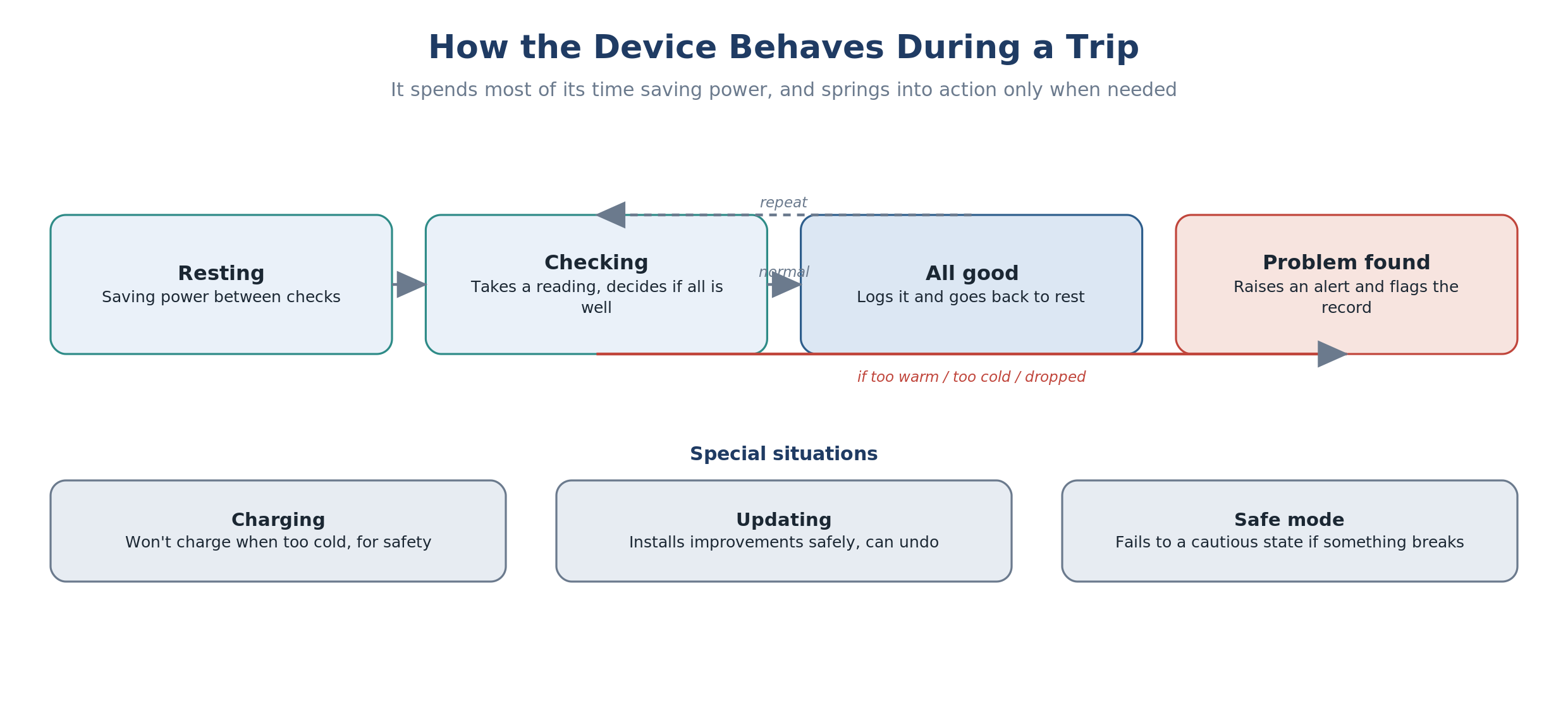
Next we turned needs into precise, checkable requirements — the difference between “it should last a long time” and “it shall run for 90 days at −30 °C.” Each requirement is written so a tester can later prove it true or false, with no argument.
In plain terms, the product must sense temperature (inside and with an external probe), humidity and shock; decide when a reading really matters to the vaccine; show a clear status on its own screen; raise an instant alert on a genuine excursion; keep a complete record even with no signal; and be easy to set up in seconds so it actually gets used at busy loading docks.
How it works — the design
STAGES 6–8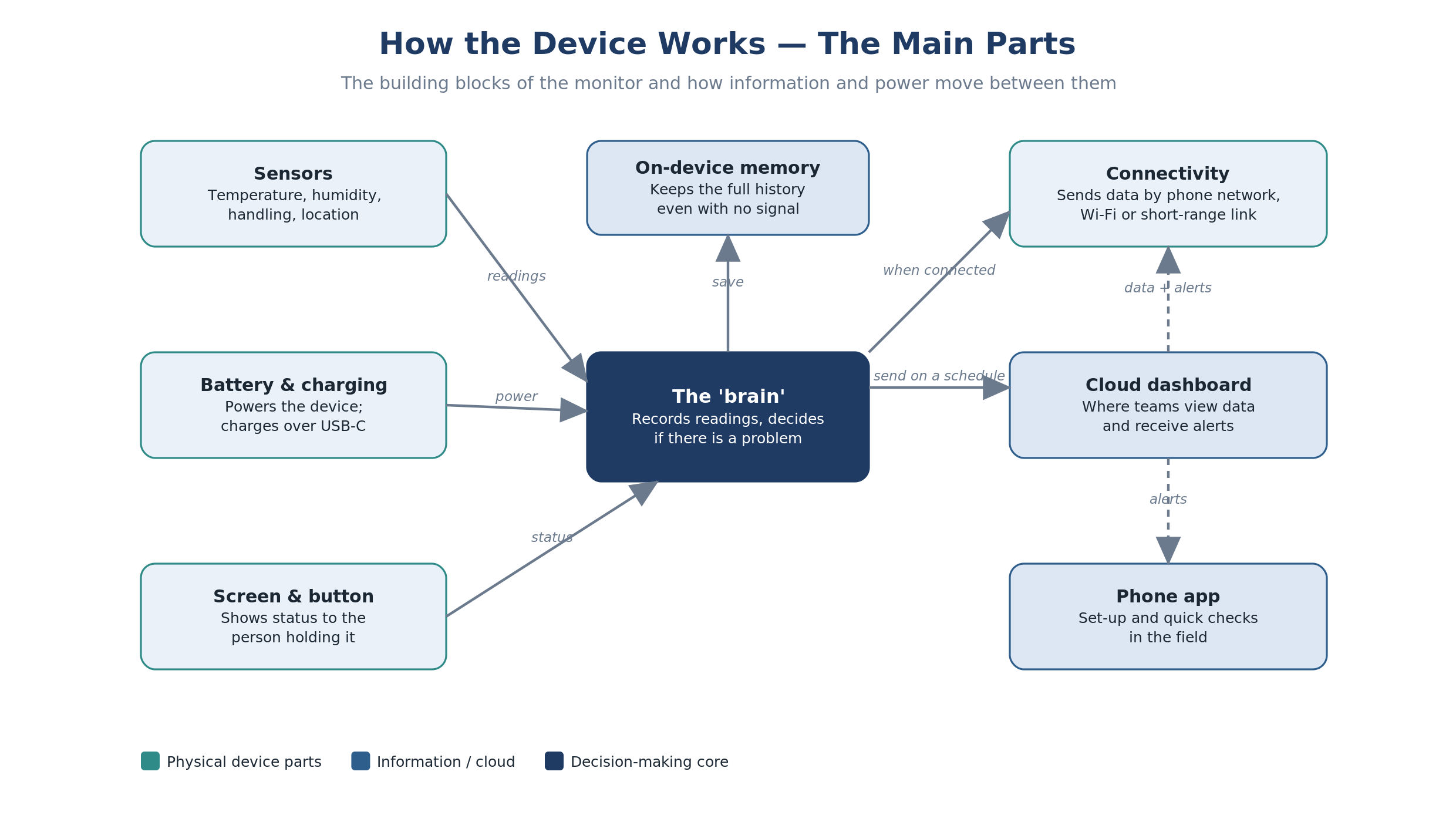
With the “what” agreed, we designed the “how.” The monitor is organised into a handful of cooperating parts: the sensors that measure the environment, a low-power brain that reads them and decides what matters, a radio set (cellular first, with Wi-Fi and Bluetooth as backups) that gets data out, a rugged power system built for the cold, a simple screen and button for the person holding it, and a cloud dashboard where fleets are watched.
We wrote this down at three levels of detail — the whole system, each subsystem, and the interfaces where they meet — so different specialists can work in parallel without stepping on each other.
The data journey
STAGE 9 · DESIGN OUTPUTS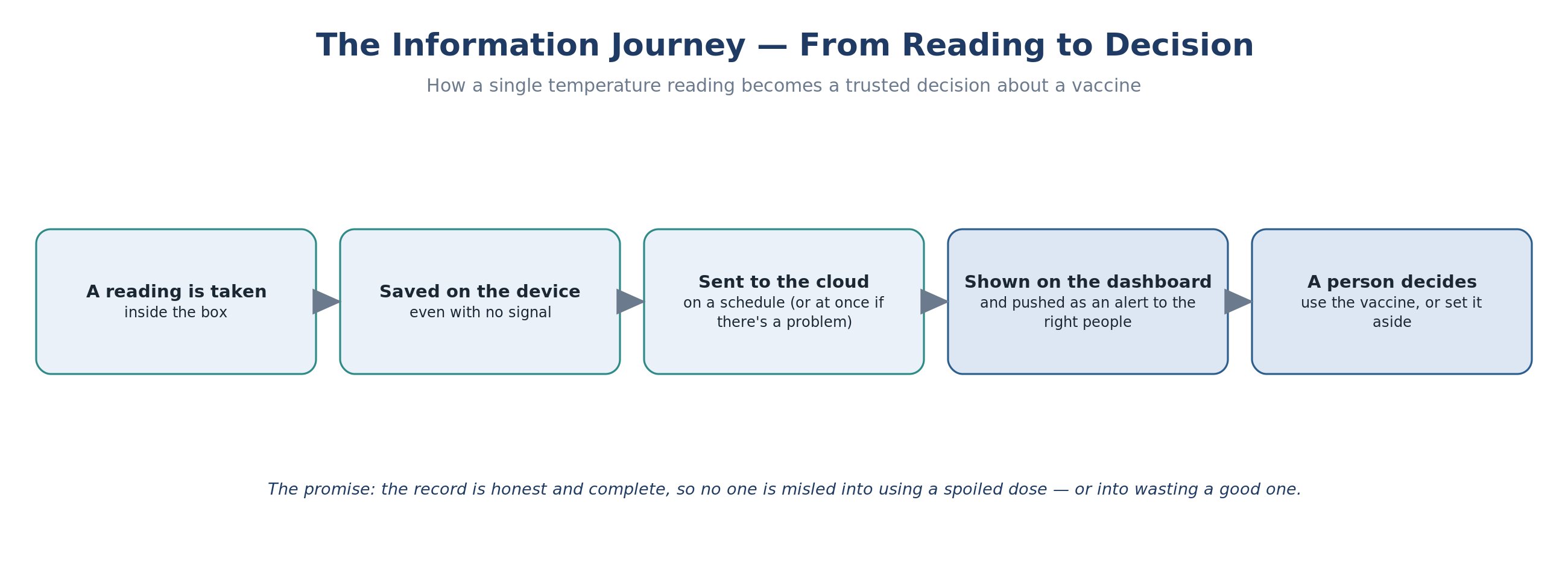
A reading is only useful if it reaches the right person at the right time. We traced the full path of a single measurement: it is taken by a sensor, judged on the device, stored safely on board, sent when a network is available (and held and forwarded when it isn’t), and finally shown as a plain accept-or-reject decision — on the device screen for the person at the door, and on the dashboard for the team.
Because connections drop out in the real world — on aircraft, in cold rooms, on the last mile — the design assumes gaps and works through them, rather than pretending they don’t happen.
90 days in the cold — the hardest problem
DETAILED DESIGN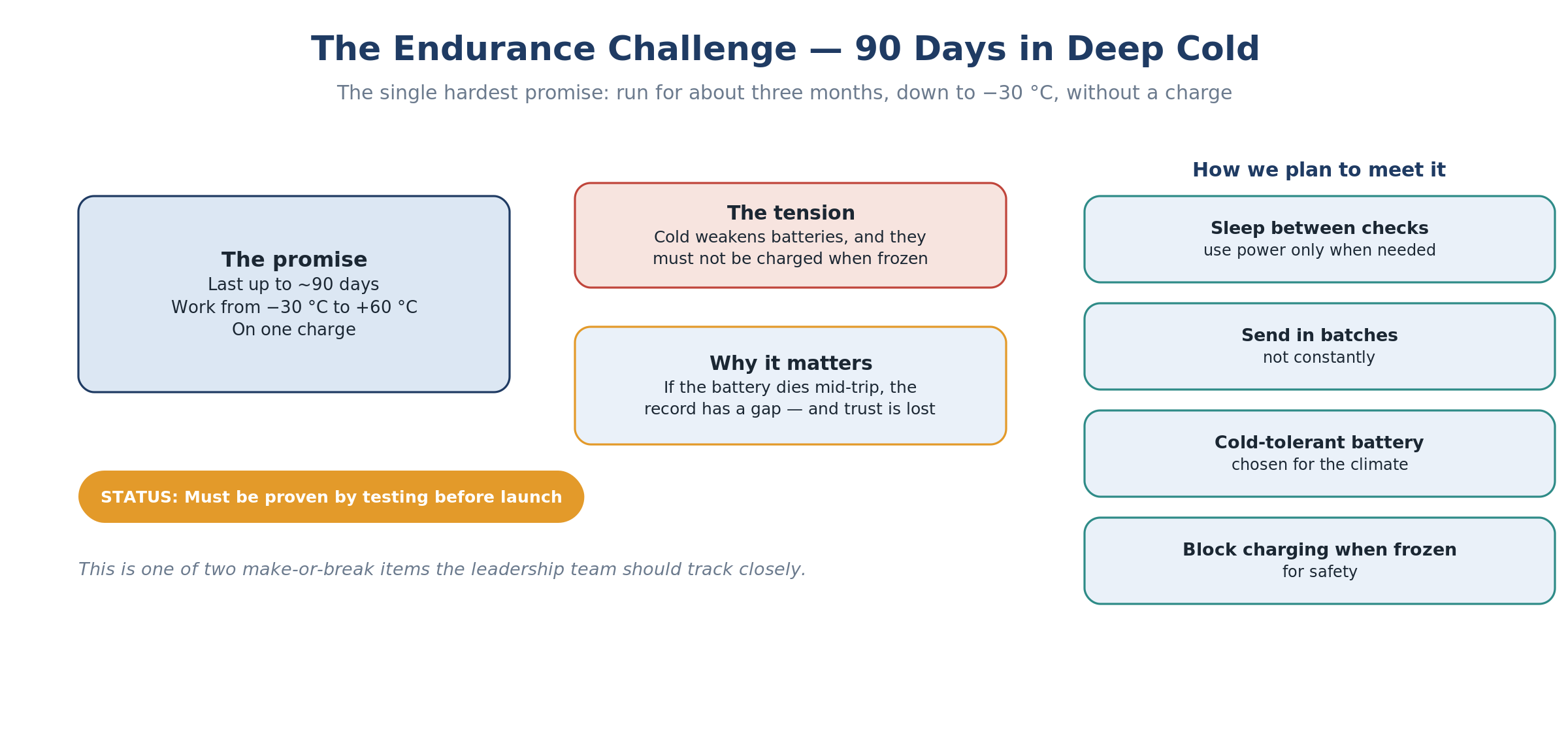
The toughest engineering challenge in the whole product is energy. Ordinary batteries lose much of their strength in deep cold and can be damaged if charged when frozen. Asking one to run a connected device for 90 days at −30 °C pushes right up against physics.
Our answer is discipline, not magic: choose a battery chemistry made for the cold; let the device sleep between readings and wake only when needed; batch its uploads instead of streaming constantly; and refuse to charge when it is too cold to do so safely. We wrote a full energy budget so the 90-day claim is a calculation to be proven by test — not a hope.
Designing out the biggest risks
STAGE 10 · SAFETY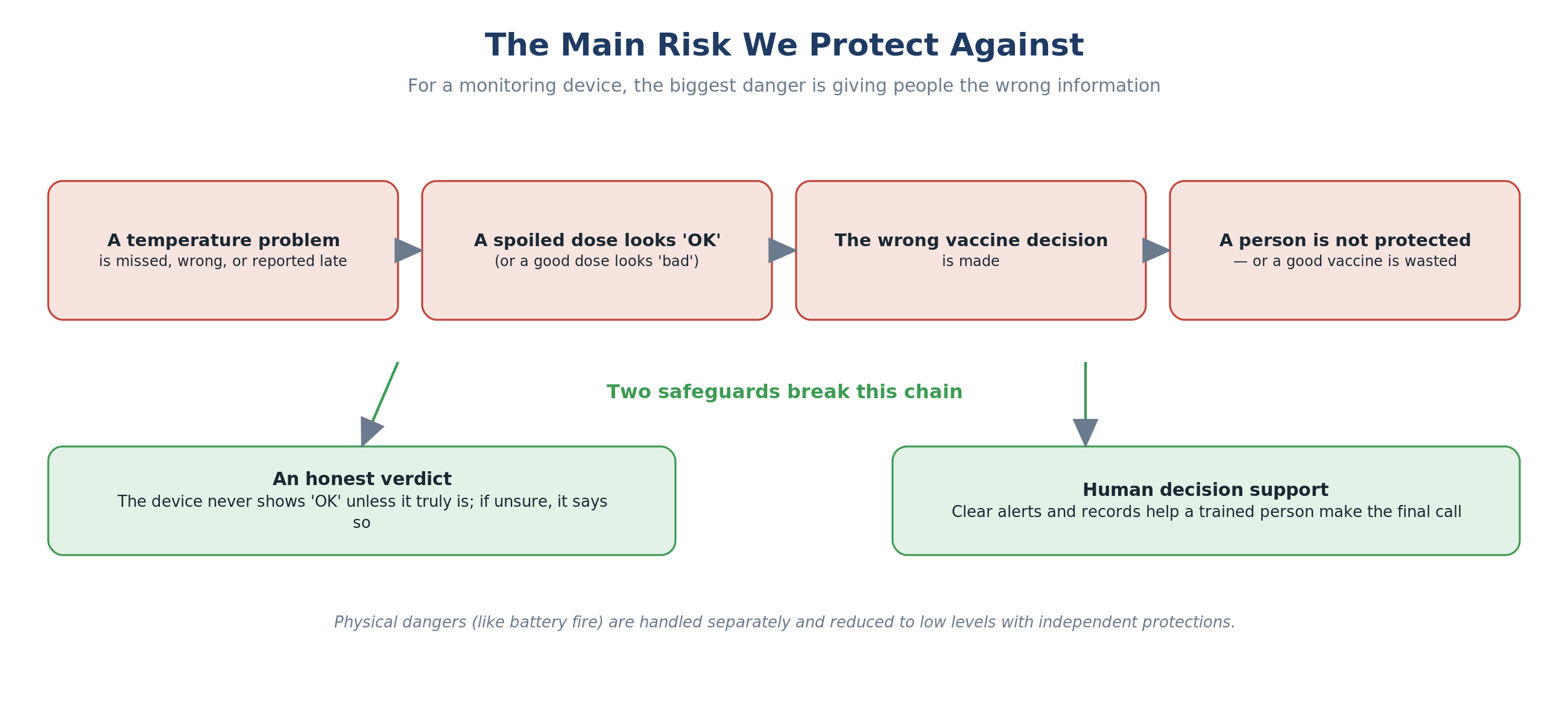
Before building anything, we asked a blunt question of every part: how could this cause harm or let vaccines be wrongly accepted? We worked through hundreds of possible failures — a missed alert, a wrong reading, a flat battery on a cold lane, a device that looks fine but isn’t — and rated each by how severe it would be first, not just how likely.
For every serious one we built in layers of protection: a second way to detect trouble, a safe default when something breaks, a clear on-screen signal so no silent failure passes as a clean pass. The worst outcome — a spoiled vaccine that looks acceptable — gets the most attention.
Battery safety by design
STAGES 11–12 · RISK CONTROLS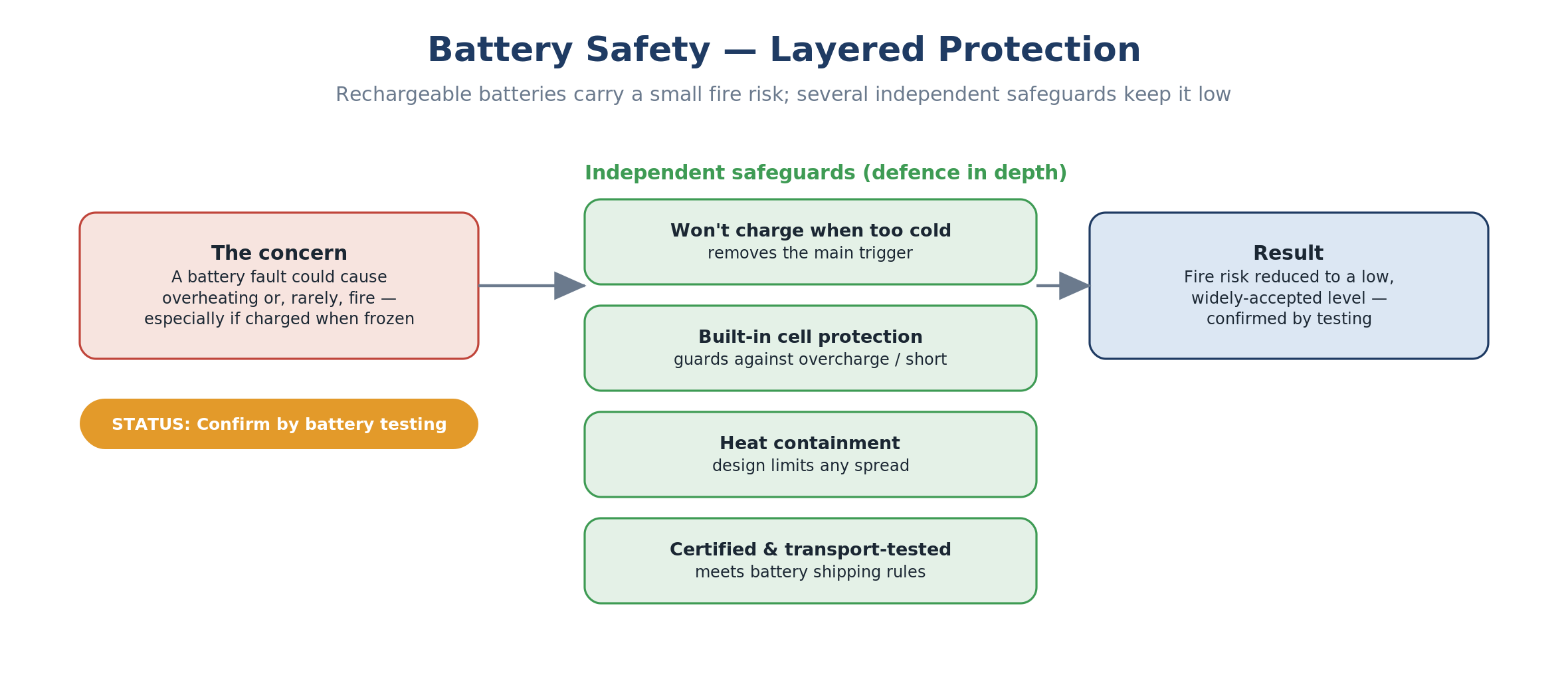
Because the device carries a rechargeable lithium battery — and travels by air — battery safety gets its own dedicated analysis. We mapped how a battery can misbehave (overcharge, over-discharge, charging while frozen, physical damage, ageing over many trips) and paired each with a specific safeguard: protection circuitry, temperature limits on charging, and rules that keep the device within the international standards for shipping lithium batteries.
Each safeguard was written up as a risk-control requirement — a promise that must itself be designed in and later tested, so safety is verifiable rather than assumed.
Proving it: testing & validation
STAGES 13–14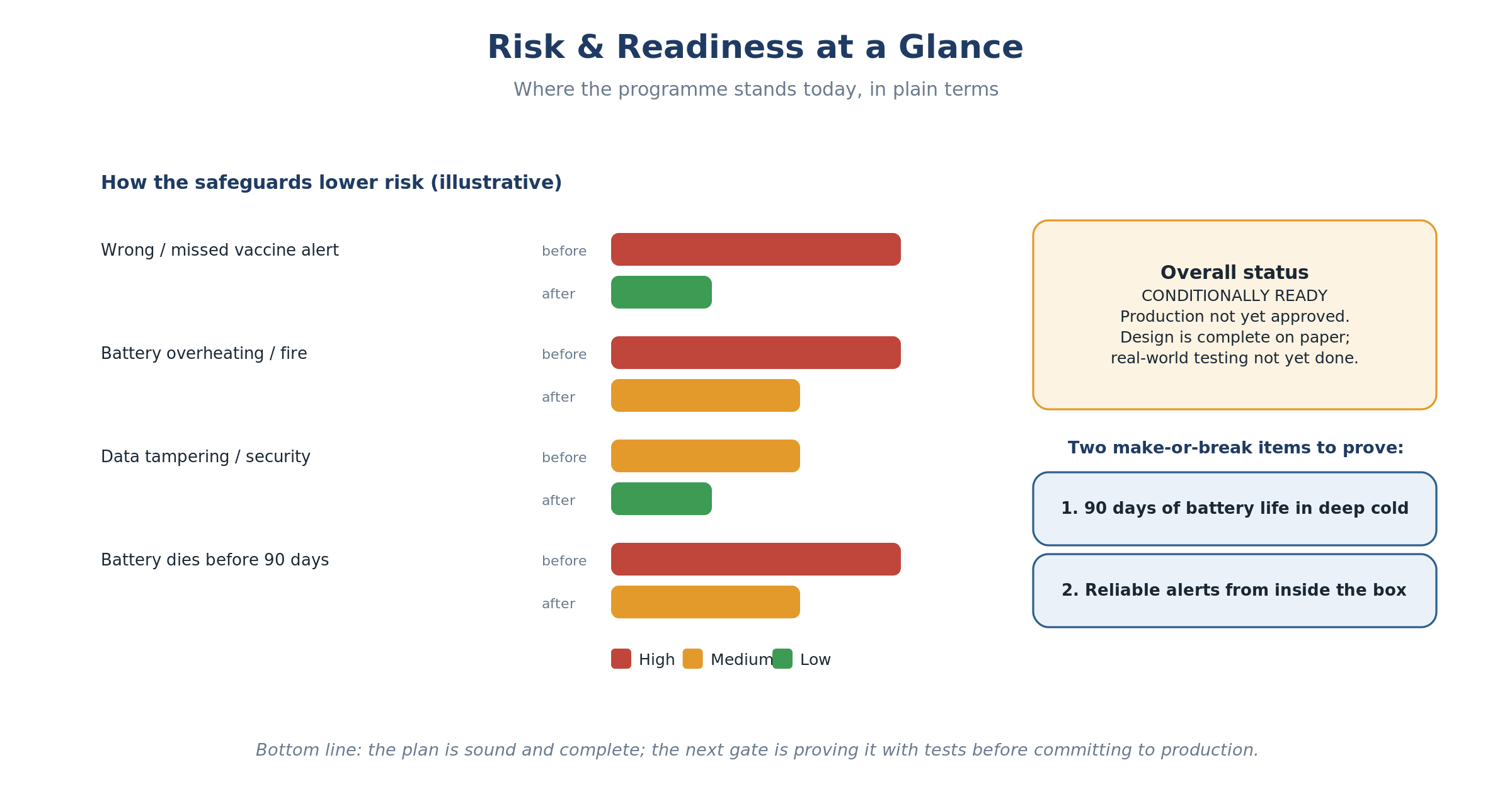
A requirement is only real once it is proven. We planned this proof in two complementary ways. Verification asks “did we build it right?” — each requirement gets a matching test, from the 90-day cold endurance run to alert timing and data integrity. Validation asks the bigger question, “did we build the right thing?” — does it actually work for the nurse, the distributor and the programme manager in real conditions?
Every test traces back to the requirement it proves, and every serious requirement has a test waiting for it — so there are no untested promises and no tests measuring things nobody asked for.
The golden thread: traceability
STAGE 18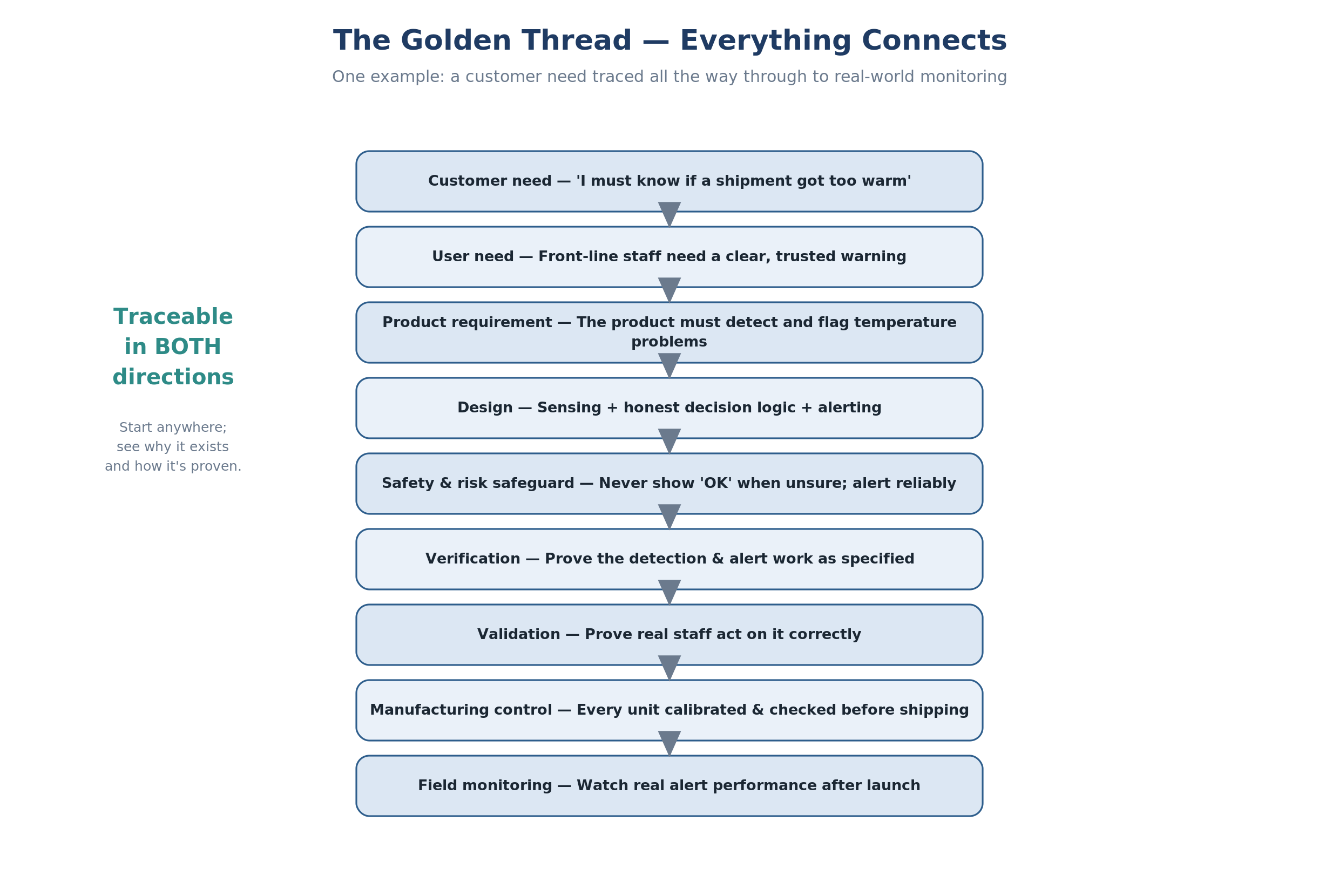
This is where the whole approach pays off. Everything we produced is linked into one continuous thread: a customer need connects to a requirement, which connects to a piece of the design, to any hazard it touches, to the safeguard that controls it, to the test that proves it. Pull on any point in the thread and you can follow it in both directions.
That means we can answer, at any moment, questions like “why does this part exist?”, “what happens if we change it?”, or “show me the evidence this need is met” — the same questions an auditor, a regulator or an investor will ask.
Making it, releasing it, and where we are today
STAGES 15–17 · STATUS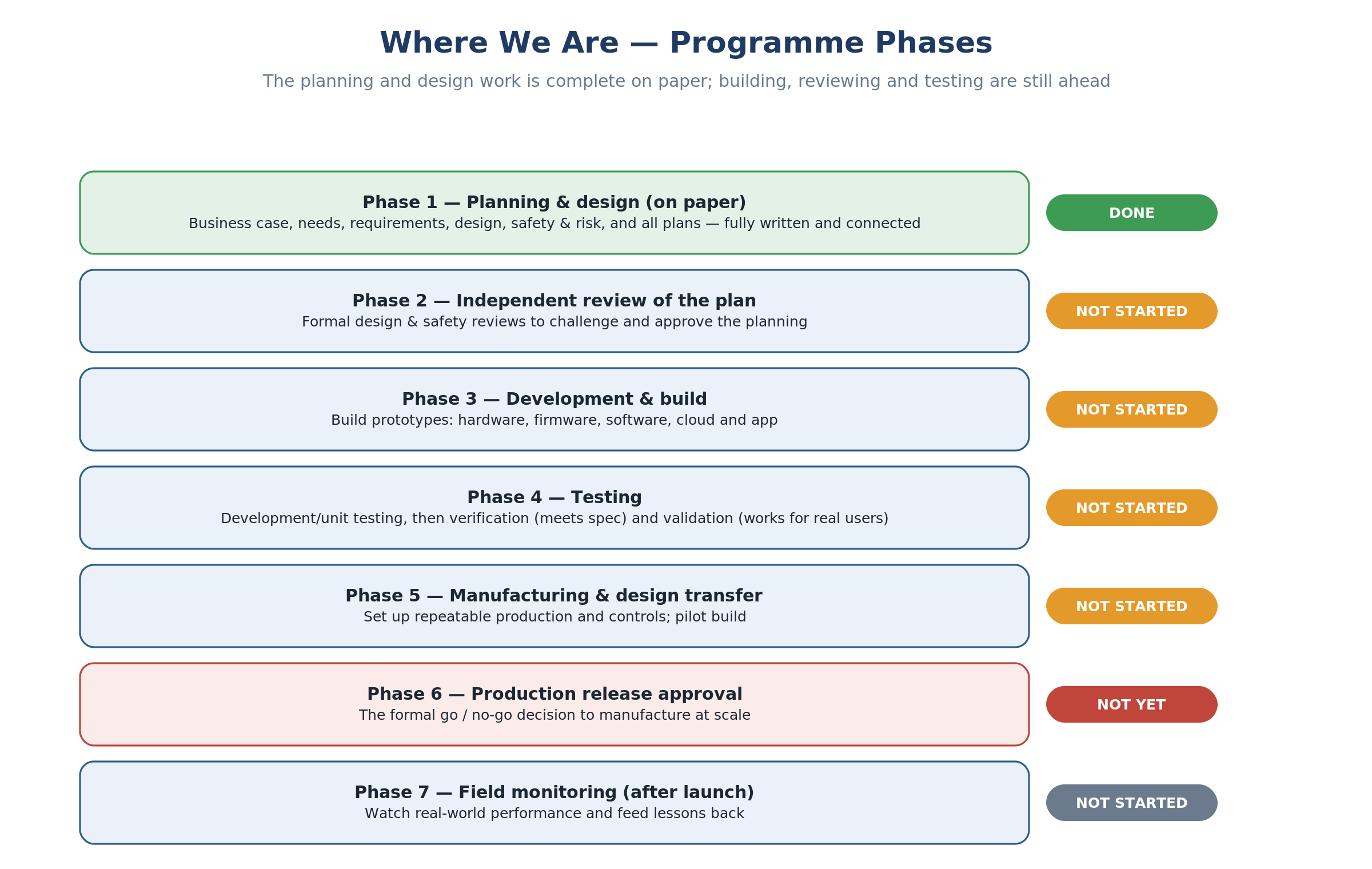
Finally we set out how the product moves from a proven design into repeatable manufacture — transferring drawings and settings to the factory, defining the checks on the line, and setting the go / no-go bar for release — and how it is watched in the field once shipping, so real-world performance feeds back into the next version.
The chart above is an honest status picture: the planning and full engineering definition are complete; the build, test, and manufacturing phases are the work that comes next. What already exists is the complete, connected paperwork that makes those next phases fast and low-risk.
The complete record
Everything described above — all 280 documents, every requirement, hazard, control and test, and the full traceability thread — is assembled into a single master workbook. Need statements, observations and requirement statements are highlighted so they are easy to find.
↓ Download the Master Product Lifecycle Record (Excel)Opens cleanly on Windows, macOS and Linux. 37 tabs · ~2 MB.