
An independent engineering review of an open-hardware RINA research node — proven as research, scoped for production.
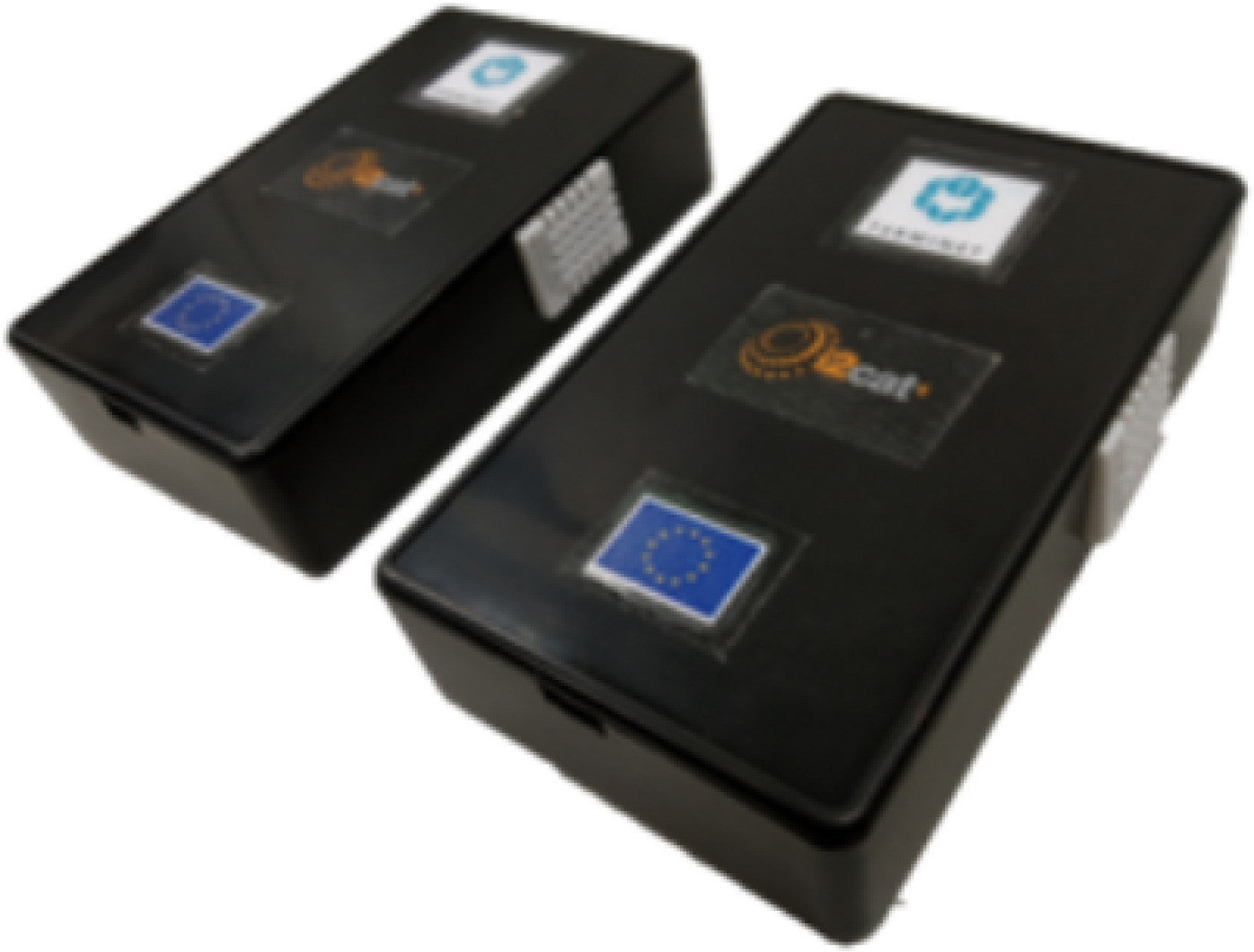
The RINAsense node is a low-cost (~€35), low-power environmental sensor built around an Espressif ESP32 microcontroller and a DHT22 temperature/humidity sensor. What sets it apart is its firmware — a purpose-built implementation of the RINA networking architecture — so the device joins and communicates over a RINA network natively, rather than over the usual TCP/IP. It was created and published as open hardware by the IoT Research Group at Fundació i2CAT (Barcelona) as a reproducible instrument for RINA research, and validated in a real smart-building testbed.
Design & files © Fundació i2CAT, published open-hardware. Reviewed here independently.
Answer one question for an open-hardware IoT sensor node: how sound is the engineering, and what would it take to move from a research instrument toward a product? Rather than judge the paper at face value, Product Engineer LLC worked up from the design's own evidence — the peer-reviewed paper, component datasheets, cited standards, and the project's actual published source code — and produced electrical, mechanical and software reviews culminating in a severity-first FMEA. Every finding is traceable; nothing is asserted.
Most connected devices talk over TCP/IP, the protocols that run the internet. To send a reading, the software connects to a numeric address and port (for example 192.168.1.100:1883) and then bolts a separate security layer (TLS) on top. If the address or network changes, the app breaks, and security is always an add-on.
RINA — the Recursive InterNetwork Architecture — takes a cleaner approach: it treats all networking as one simple, repeating idea. A device joins a named network (called a "DIF" — think of it as a members-only club you join by name) and then reaches other applications by name, not by address. And security and quality-of-service are built into the club's rules: a device that is admitted automatically inherits them, instead of each app adding its own.
Why it matters for IoT: simpler device code (no hard-coded addresses), built-in authentication (an unauthorised device is refused at enrolment — which the authors demonstrated), and a design that scales from one sensor to a whole network by stacking these named layers. RINAsense is a working proof that this can run on a tiny, low-power chip.
Each step feeds the next — from reading the paper to a two-variant system FMEA.
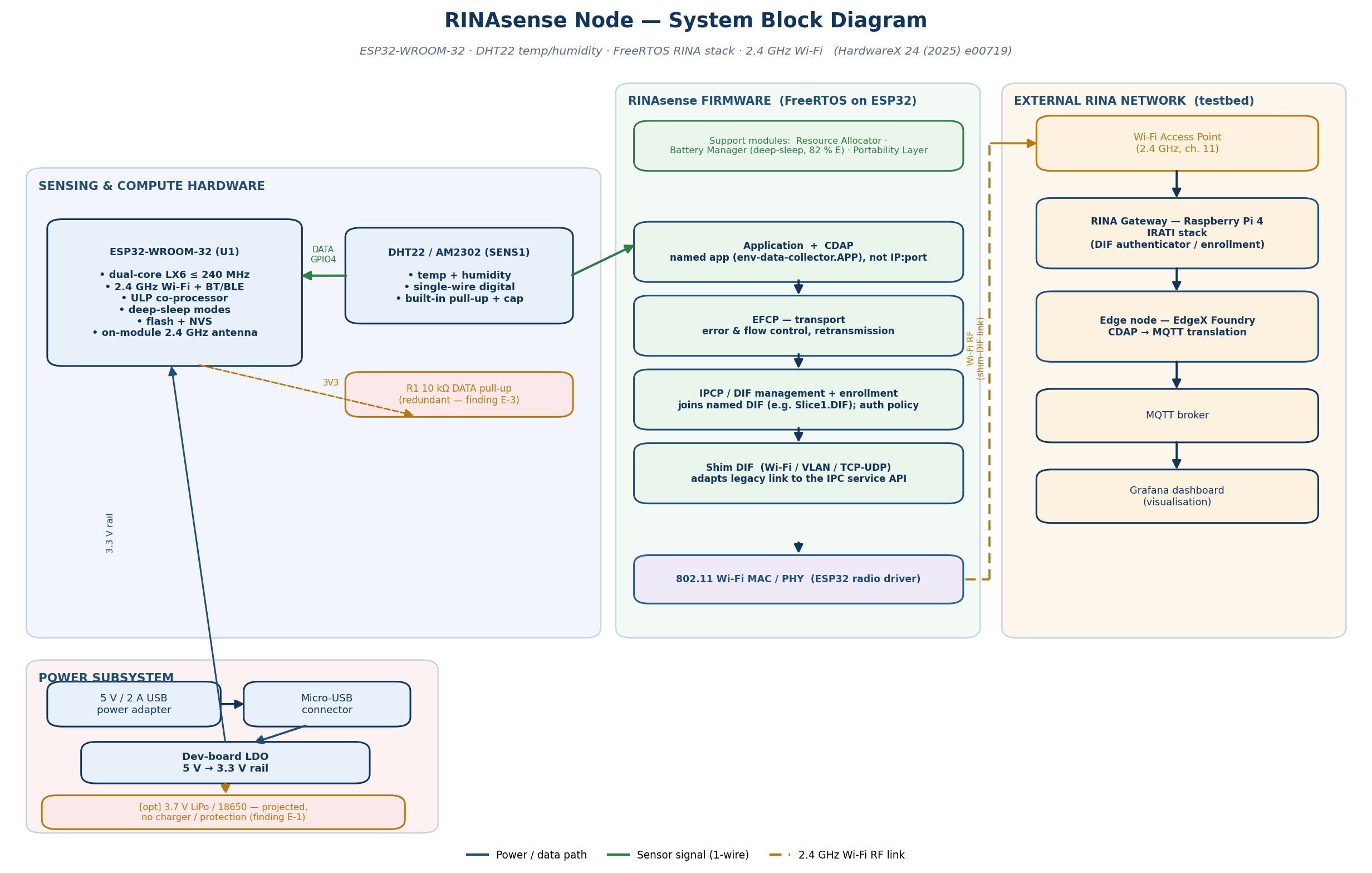
The node's hardware, its layered RINA firmware stack, and the external RINA testbed it joins.
As a RINA / networking research platform the design is genuinely credible — working, reproducible, open, and peer-reviewed. Two honest caveats sit under the "scientific instrument" label: a sealed, unvented enclosure can bias the temperature/humidity readings well beyond the sensor's own accuracy, and the headline battery life is optimistic because it was measured bypassing the development board's own power draw. It is not a product and was never presented as one — a production version would need a real PCB, a protected battery front-end, a rated/vented enclosure, a proper device-security stack (secure boot, encrypted per-device credentials, secure updates), and EMC/safety qualification.
Every figure comes directly from the design's own evidence and checked against the relevant standards. Notably, the security findings are read directly from the project's published configuration file, not inferred.
Design evidence: the RINAsense HardwareX paper (2025), the open-access technical text and design files, the ESP32-WROOM-32 & DHT22 datasheets, and the project's published source configuration.
This is an independent engineering review of an openly published, peer-reviewed design; it exists only because the original authors shared their work as open hardware and open access. Full credit to David Sarabia-Jácome, Eduard Grasa and Marisa Catalán of Fundació i2CAT (Internet of Things Research Group, Barcelona), whose RINAsense node and firmware — released under Apache-2.0 (firmware) and CERN-OHL-S v2 (hardware) — made this analysis possible. The work was funded by the European Union Horizon 2020 programme (TERMINET project).
Project & paper: RINAsense in HardwareX (2025). Technical details & design-file downloads: open-access full text (PMC).
Product Engineer LLC is not affiliated with Fundació i2CAT. This review is offered constructively to support an open-source project.